Tuesday, June 25, 2013

Sakhi Series :- 222 (A Visitor from Rome)

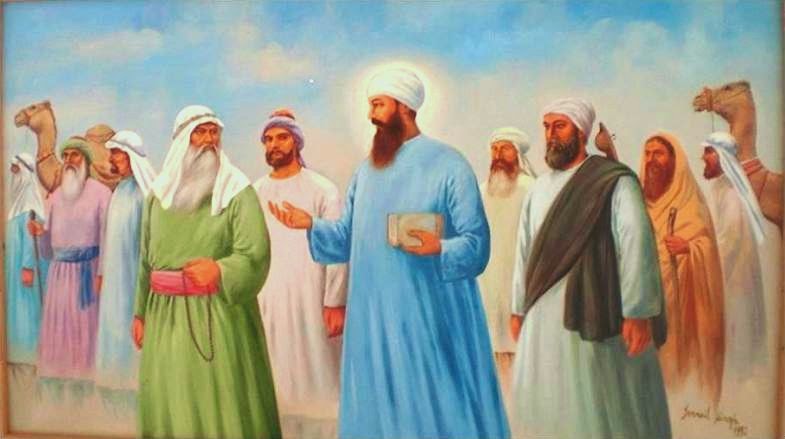
A Visitor from Rome

At the beginning of the 17th century, many Europeans came to India. In those days India was well known for its wealth and variety of faiths. It was called a 'Golden Sparrow.' Many of the visitors came as traders and their purpose was to get rich by trade. Some others came as missionaries to spread their religions.

Rome was the capital of Italy. It was well known as the centre of Christianity. The king of Rome sent a missionary to India. The missionary travelled up and down the country for many years. During his travels he met many Moslem saints and Hindu Pandits. He had heard a lot about Sikhism from a Masand (agent) and wanted very much to see the Guru in person. He wanted to know more about Sikhism through a discussion with the Guru. Therefore he came to Kiratpur (Punjab) and stayed there for two days.

When he met the Guru he asked him a number of questions about Guru Nanak Dev ji and the later Gurus. He said, "There have been so many prophets. Who is the True Saviour?"

"The prophets and the Gurus enlighten us," said the Guru. "They make us aware of God and they show us the right way to lead our lives. It is our good actions, truthful living and love for God and His creation which will save us. None of the prophets can save us if our actions are bad. It is not the prophet who saves anybody, but it is his teachings that, if followed, lead us to salvation. The sad fact, however, is that we attach more importance to prophets themselves and forget the teachings they leave for us during the time they live among us."

"How did God create life on our earth?" asked the missionary.

God and His works are best known only to Him. But we Sikhs believe that

"The True Lord created the air, 
Air gave birth to water;
 
From water sprang forth life,
 
And the Lord is within everything he created."
 
(Guru Granth Sahib)

"Which is the best religion?" enquired the missionary. "The best of all religions," said the Guru, "is to meditate on God's Name and to act rightly."

"Dear "Sir," said the missionary, "I have travelled through almost the whole of India and have seen people observing caste and calling the low caste people inferior. What is your idea about caste?"

"Caste and rank," said the Guru, "depend on actions. The pride of caste is folly and the root of evil. The whole creation is God's work. As a potter makes different vessels from the same clay, so has God made different men to please Himself. Each of us is composed of the same elements. No one is high and no one is low. Being the sons of the same father we are all equal. We are all bound by our actions and without God's grace there is no salvation."

"Whom do the Sikhs call a saint?"

"A saint is he who is aware of the presence of God at all times, 
He regards the will of God as sweet,
 
His only support is the Name;
 
He is as humble as the dust under anybody's feet
 
He finds comfort only in God's praises,
 
And regards friends and foes alike.
 
He knows none as well as God."
 
(Asa 5 Guru Granth Sahib)

 "What importance should man attach to pilgrimage?"

"If you want to gain true knowledge 
Make people's welfare your aim in life.
 
When you master your five senses,
 
Life itself will become a pilgrimage."
 
(Rag Asa Guru Granth Sahib)

"Is it necessary to have a Guru?"

"Dear brother ! the medicine of God's name is within all of us, 
But without the Guru we do not know how to use it.
 
The perfect Guru administers it with necessary rare,
 
And the disease is cured once for all."
 
(Gauri Bawan Akhri)

"Why don't the Sikh Gurus work miracles?"

"Miracle delude fools only, 
Who have no God in their hearts.
 
Except the true Name, Nanak has no miracle."
 
(Guru Granth Sahib)

"Is there any merit in alms-giving?"

"Yes, he who earns by honest labour and gives something out of that in charity, has found the true way to the Lord." 
(Guru Granth Sahib)

"Does knowledge lead to salvation?"

"No, knowledge must be supported by actions. Some people repeat the words of knowledge like the cawing of a crow, but their hearts are full of greed, falsehood and pride. Without the true Name and good actions they will not find peace." 
(Guru Granth Sahib)

"Who are the chosen people of God?"

"The Lord's chosen are those who are absorbed in His Name. 
For them there is no fear of birth or of death.
 
They have attained the Lord.
 
Great honour is theirs in all regions."
 
(Guru Granth Sahib)

 
"What is your idea of life after death?"
 
"Human life is a stage in a long journey of the soul. Death destroys only the body but the soul leaves the body and finds a new dwelling. It is like a person casting off his old worn-out clothes and putting on new ones. Our soul is a part of God, but soiled by sin it keeps on changing forms until it once again becomes pure enough to merge with God." 
 
The missionary was very much impressed by the Guru's way of life and his religion. He is said to have praised the Guru very much in his writings.
  

"He who looks on all men as equal is religious; 
Religion consists not in wandering to tombs,
 
Nor to places of cremation, nor sitting in silence;
 
Religion consists not in wandering in foreign countries,
 
Nor in bathing in the places of pilgrimage.
 
Remain pure amidst the impurities of the world;
 
Thus shall you find the way to religion."
 
(Guru Granth Sahib)

Monday, June 17, 2013

Sakhi Series :- 221 (Bhai Nihang Khan)

Bhai Bachitar Singh


Bhai Bachitar Singh was born on 6th May 1664 and took Amrit on the historic day of Vaisakhi on 30th March 1699. Bhai ji is most famously remembered as the Singh who attacked a drunken elephant.

The sakhi goes as Sri Guru Gobind Singh Ji and a small number of Sikhs were defending their position in Lohgarh fort of Anandpur Sahib, which was under attack by numerically far suprior forces under the rule of the Moghul Emperor Aurangzeb and the Hindu rulers of the Hill States. Despite superior numbers, the besiedging forces were unable to penetrate the heavily-defended fort. They brought forth an armoured, druken elephant to batter in the gates. Bhai Bachittar Singh was tasked with stopping the elephant, armed with a nagni barcha (snake shaped spear), a type of spear. Bahi Bachitar Singh ji rode out of the fort on horseback and attacked the elephant, thrusting his spear into the animal's forehead and cutting its trunk with his sword. The wounded elephant retreated, disrupting the attackers' ranks.

In December 1705, when Guru Gobind Singh Ji decided to evacuate Anandpur Fort, they came to the River Sirsa. Whilst crossing the river, the Chotte Sahibazade along with Mata Gujri ji were separated from Guru ji. Guru Gobind Singh ji along with 40 other Sikhs came to Ghanaula village before reaching Macchiwara jungle. Some of the 40 Singhs included Guru jis two older Sahibzade, the Panj Piare, Bhai Sant Singh Ji, Bhai Jeevan Singh ji and Bhai Bachitar Singh Ji.

After resting at Macchiwara Jungle, Guru ji asked Singhs to do Asa di Vaar Kirtan. Around the same time some Mughal forces had manged to catch up with Guru ji. Guru Ji asked a few Singhs to fight against the oncoming forces whilst some did Asa di Vaar Kirtan.

Sahibzada Ajit Singh ji along with Bhai Jeevan Singh ji and Bhai Bachitar Singh Ji fought agianst the oncoming enemy. The enemy recognised Sahibzade Ajit Singh ji as the Son of Guru Gobind Singh Ji and decided to try and kill them. In this battle, Bhai Bachittar Singh ji was seriously wounded. Bhai Madan Singh and Sahibzade Ajit Singh ji carried the injured Bhai Bachittar Singh ji to Malikpur Rangharan, to the house of Nihung Khan. Guru Gobind Singh asked Nihang Khan to look after Bachittar Singh, after which he proceeded with the remaining forty or so Sikhs towards Chamkaur. Guru Gobind Singh ji before his departure bestowed upon Nihang Khan a sword, a dagger and a shield.

Rumors spread as quickly in those days as they do today, so hearing that Nihang Khan was sheltering some Sikhs, the Mughal troops searched his house while the mortally wounded Bachittar Singh lay in a small room attended by Nihang Khan's daughter. Living up to his name, Nihang Khan maintained his cool and succeeded in keeping the search party from entering the room by telling them that his daughter was nursing her very sick husband. Mughal soldiers believed in what Nihang Khan said, but confirmed from Bibi Mumtaz , '' Who is inside with you''?? Mughals asked.
''Its me and my husband here inside, he is sick'' replied Bibi Mumtaz!

Confirming that Guruji was not in house or village of Kotla, Mughal Army started its pursuit of Guruji.

Thus the danger was averted, but the life of Bhai Bachchittar Singh could not be saved. He succumbed to his injuries and breathed his last on 8 December 1705. Nihang Khan had the cremation performed secretly the following night.

Today that village is known as Kotla Nihung Khan. The sword, dagger and shield presented to Nihung Khan by Guru Gobind Singh ji were preserved and passed through generations in the family, but no shrine was raised to the Guru's visit in that most fateful night of peril - until Gurdwara Bhattha Sahib was constructed by Sant Baba Jivan Singh (1833-1938) of Buddha Bhora on the site. The construction was commenced in 1910 and completed in 1923. When the Pathan family left India, following the partition of 1947, they presented the sword and the dagger at the Gurdwara, but the shield was taken by the family who next occupied their house.

Wednesday, May 29, 2013

Sakhi Series :- 220 (Guru Nanak Dev ji in Mecca)

Guru Nanak Dev ji in Mecca
 

Bhai Gurdas ji Vaar : Baba at Mecca Pauris: 32-34

Baba phiri Makkey gia neel bastatr Dharey banwari.

Aasa hathh Kitab Kachh kuja bang mussala dhari.

Ja Baba suta raat nounn vali maharabey paiye pasari.

Jivan maari latt di kehara suta kuffar kuffari.

Tangon Pakkaur ghasitia phiria Makka kalla dikhari.

Hoey hairan kareni Juhari.


Puchhan Pholi kitab nounn Hindu vada ke Musalmanoi.

Baba Aakhey hajian subh amlan bajhau dono roi.

Hindu Musalmaan dui dargah andari lahani na dhoi.

Karani bakhili aapi vichi Ram Rahim Kuthai Khaloi.

Rahey Saitani dunia goi.


In these pauris Bhai Gurdas ji describes the visit of Baba Nanak (Guru Nanak Sahib Ji) to Mecca(during Guruji's 4th udasi/journey to the west). Donning blue clothes, holding a stick in one hand, book under the arm pit and carrying his prayer mat and a lota (jug) Baba reaches Mecca and relates the well known anecdote about Guru Nanak Dev ji keeping his feet towards the Mehrab at night.
 
When the Mullah named Jiwan saw this act of sacrilege, he was infuriated and kicked him, saying that who is this Kafir keeping his feet towards the house of God and holding (Guru)Nanak Dev ji's legs pulls them to change their direction and sees the "Mecca moving in the same direction".


Hearing that a strange man had crept into their company, people gathered round him and asked to open and search in his book(pothi) and tell them as to who is better, Hindu or Muslim. Guru ji replied, "Without good deeds, both will come to grief. Only by being a Hindu or a Muslim one can not get accepted in the court of the Lord."   As the colour of safflower is impermanent and is washed away in water, likewise the colours of religiosity are also temporary. (Followers of both the religions) In their expositions, denounce Ram and Rahim. The whole of the world is following the ways of Satan.


Then they asked, "Of what religion art thou?"  Guru ji answered, "I am a mere man, made up of five elements, a play thing in the hands of God."


PS: Some might ask - Why did Guruji visit Mecca ? 
Guess, for the same reason Guru Jee visited Hardwara (Hiduism HQ), Mount Kelash (Siddha's), Lhasa (Buddhist HQ), Rome etc

People were lost in hatred and segregation on the lines of caste, creed and religion. The reason was to bring about change; people had become misguided so Guru Jee went to get people to follow the True path.

If someone wants to bring about change in UK, they must go to where policies in UK are made eg Parliament and hold discussions/dialogues/debates. In the same way, for Guru Jee to bring change amongst Muslims, Hindu's, Buddhists of that time. He had to visit the centre of all these religions and have dialogue/debates/discussions with their leaders. Guru Jee went to Mecca, Median, Hardwar, Lhasa, Rome (etc) with the sole purpose of teaching the True path:
-That God is everywhere and in everyone. 
-To treat ALL humans with respect and equals 
-To teach tolerance and respect. 

"I do not make pilgrimages to Mecca, nor do I worship at Hindu sacred shrines. I serve the One Lord, and not any other. I do not keep fasts, nor do I observe the month of Ramadaan. I serve only the One, who will protect me in the end." (Siri Guru Granth Sahib Ji, Ang 1136).

Wednesday, May 22, 2013

Sakhi Series :- 219 (Baba Narain Singh Nabha)

Baba Narain Singh Nabha
(Source : Katha Bhai Pinderpal Singh ji - Gursikhi ki hai-1)
 
Baba Narain Singh ji(father of Kahn Singh Nabha) was a saintly person who had whole of Guru Granth Sahib jee memorized and regularly recited the Guru Granth Sahib four times a month.
Thrice in his life he recited the Guru Granth Sahib in one sitting (Ati/Atee Akhand Path). An Atee Akhand Paathee is such Khalsa who can do the whole of Siri Akhand Paath Sahib in one sitting without stopping. This is completed usually in 9 Pehars (ਪਹਰ) or 27 hours

Once Maharaja Hira Singh of Nabha sat with him to listen to the Akhand Path recitation and on completion of the path was so happy that he offered Bhai Narain singh Nabha a Jagir (estate). On listening to the offer Bhai Narain Singh ji said - is that it ?

Maharaja Hira singh thought - maybe Narain Singh wants more and said - ask anything bhai sahib ji ....

On listening to which Narain Singh ji said - this is the reason i do not do path at rich peoples home - they try to put a price tag ..... He then humbly requested "If you really want to give me something then PLEASE do ardas for me that Guru Sahib blesses me with his sewa and that he remains a humble servant of Guru Granth Sahib ji till the end"
 
As a mark of respect, Maharaja Hira Singh, on that occasion became one of Baba Narain Singh's palanquin bearers.
"Standing Lto R : Baba Budh Singh and Bhai Gopal Singh Sitting L to R : Bhai Mihan Singh (younger brother of Bhai Kahan Singh Nabha) with Child Bhagwant Singh Hari ji, Baba Narain Singh (Father of Bhai Kahan Singh), Baba Uttam Singh, Bhai Bishan Singh (Younger Brother of Bhai Kahan Singh)"
 

Monday, May 13, 2013

Sakhi Series :- 218 ( JHOOLDE NISHAN RAHIN PANTH MAHARAJ DE !!!!! )


JHOOLDE NISHAN RAHIN PANTH MAHARAJ DE:


Once, a Nishan Sahib bearer Sikh named Bhai Alam Singh was captured by the Mughals during the second battle of Anandpur Sahib, as he advanced far forward than the Sikh positions, and continued to carry the fluttering Sikh Nishan Sahib proudly and without fear. He soon found himself surrounded by the enemy soldiers. The Mughal Commander ordered Alam Singh Ji to "throw the Nishan Sahib down ".Bhai Alam Singh Ji replied, "THIS Flag is the symbol of my personal dignity and that of my Guru and I will never let it fall".

The Mughal Commander then says "we will cut off your hands, in that case."

Bhai Alam Singh Ji without an iota of fear, replied, "In that case, I will carry the Nishan Sahib with my feet." The Mughal said, we will cut off your legs too.

Bhai Alam Singh Ji boldly defying, responded, "Then, I will hold it between my lips, with my mouth! This flag belongs to my GURU, I will never let it fall ever"

The commander retorted, 'we will blow your head off, what will you do then? 'Bhai Alam Singh Ji responded by saying "In that case "The Guru whose flag he was carrying will take care of it ! But while I breathe, I will hold it high".

In those days, the rules of war were that no flag carrier was ever killed or shot by the enemy, but the Mughal commander seeing such fierce and emboldened defiance from Bhai Alam Singh; with one swipe, cut off Bhai Alam Singh Ji's head, in clear violation of the agreed rules of engagement in battle.

But it is said that before the Nishan Sahib could fall to the ground, Guru Gobind Singh Ji's [son] Sahibzada, Baba Ajit Singh Ji appeared and took hold of the Nishan sahib and held the Nishan Sahib high with one hand, while with the other he slayed off the head of the Mughal Commander, spreading fear and chaos in the ranks of the enemy!

This is the as how the Nishan Sahib was held in great esteem by the Sikhs in those days

Brief History: 
It is said words "Waheguru Ji Ki Fateh" in Punjabi script (Victory of God) was inscribed on the Nishan Sahib of Guru Gobind Singh Ji. During Maharaja Ranjit Singh's times words "Akal Sahai" in Punjabi script were unscribed on the Nishan Sahib. During times Sikh Misals, "Nishan Walia" Misal used to provide Sikhs for carrying Nishan Sahib to all the Misals during battles. Nishan Sahib on Pole of suitable height is hoisted on all Gurdwaras.

A flag represents loyalty, unity and distinction. Nishan Sahib stands for the Sikhs in their body, mind, and action. It is an assertion of their physical, mental and spiritual independence, and of the UNITY under its protection. It announces the purity of their thought, and spiritual elevation through their belief in ONE God, faith in their Gurus as well as Guru Granth Sahib ji, and in the edicts of the Sikh faith including the discipline of Amrit. It proclaims their faith, beliefs, high morale, honest conduct, hard work, truthfulness, justice, forgiveness, equality, liberty - live and let live attitude, compassion and helpfulness to the needy etc

Watching a gently fluttering flag lifts up the mind with joy.

Fact : There are 2 Nishan Sahibs in front of Akal Takht Sahib. The Jhanda(nishan) Sahib towards Akal Takht Sahib is one foot shorter than the other (towards teh Darbar Sahib), as the one representing the spiritual or Heavenly realm is seen as the more important of the two.